
Let’s start with a few simple questions:
🔹If we use a 20 ft container to transport just 10 kg low volume material, do you think it’s cost-effective?
👉 Obviously not. The container will be underutilized, and you’ll be paying for unused capacity.
🔹If we try to carry 2 ton of material on a 3-wheeler transport tempo, what will happen?
👉 The vehicle will be overloaded, maintenance cost will shoot up, and there will be serious safety risks.
So, as we know, the transport mode should always match the load and duty. Only then it become cost-effective and reliable.
Now, Think About Cranes
Why Do You Need to Classify Cranes by Duty Cycle or Service Class?
Crane service classifications allow you to select and build a crane that is the most economical and safest design for your lifting application.
This is exactly why standards define “Mechanism Class.”
It helps you:
- Match the crane’s duty cycle with your actual load requirements.
- Avoid overspending on unnecessarily heavy-duty cranes.
- Prevent breakdowns and high maintenance costs by avoiding under-designed cranes.
- Ensure safe, reliable, and cost-effective crane operation over its full lifecycle.
👉 So, when buying a crane, always ask yourself:
- What is the actual load pattern in my plant?
- How often will the crane be used?
- Which mechanism class fits my application best?
Only then you will get the right crane, at the right cost, with the right reliability.
How to decide the Mechanism Class/Duty?
When it comes to deciding the mechanism class of a crane, you’ll find plenty of articles online. But let’s be honest—most of them are too technical and confusing. That’s why many buyers simply leave this decision to the manufacturer.
As mechanism class directly impacts crane’s cost, performance, and reliability. If the class isn’t right, you might end up paying more in the long run, either through higher maintenance or reduced efficiency.
That’s why, as a responsible buyer, it’s important to verify the class suggested by the manufacturer. Don’t worry—we’re here to make this process simple. In this article, I’ll break down how to finalize the right class for your crane in the easiest possible way. And if you’d still like expert guidance, we’re just a call away.
According to FEM 9.511(Rules for the Design of Series Lifting Equipment; Classification of mechanisms),
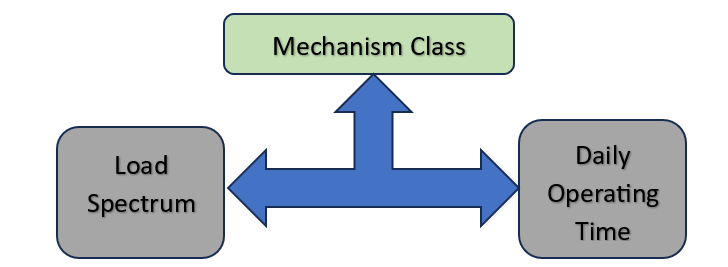
- Load Spectrum means, how heavily the crane or its mechanism is typically loaded during operation.
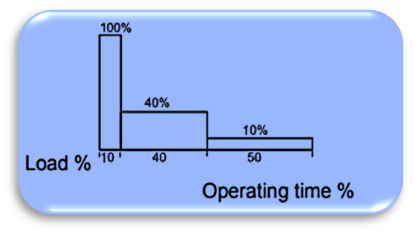
There are 4 load spectrum-
- Light Duty – For a Light-duty application, Crane usually handles around 10% of its rated load, and about 90% of the time it lifts only very light loads
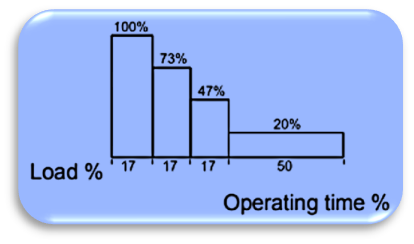
2. Medium Duty – For a Medium-duty application, the crane usually handles 20-30% of its rated load, and about 70-80% of the time, its lifts light load.
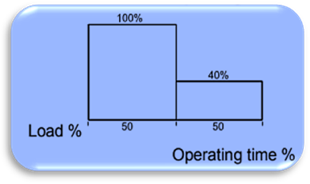
3. Heavy Duty – For a Heavy-duty application, crane usually handles 50% of its rated load, and about 50% of the time its lifts light-medium load.
4. Very Heavy Duty – For a Very heavy-duty application, crane usually handles 90% of its rated load, and about 10% of the time its lifts medium load.
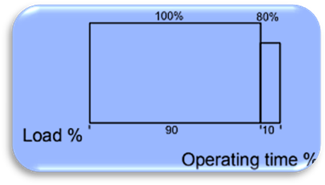
B. Daily operating Time– after load spectrum daily operating time is to be determined.
T = 2 x H x N x T
V x 60 …………Where,
H = Avg. Hoisting height (m)
N= Hoisting Cycles /hour
T= Daily Working Time (Hrs.)
V= Hoisting Speed- (m/min)
Once you know how the load is distributed (load spectrum) and how many hours per day the crane is used (daily operating time), you can use the chart to find the correct classification.
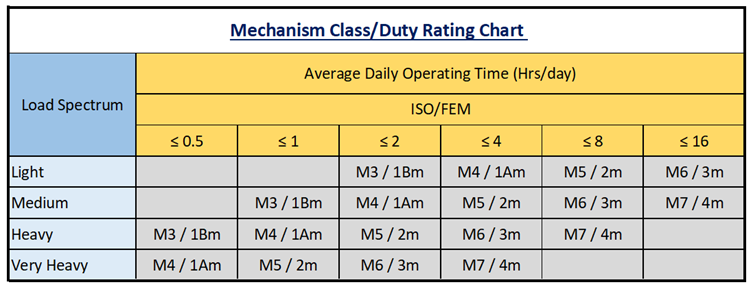
📢 In India, the most commonly used crane duty classes are M3, M5, M7, and M8.
To make it super simple, I’ve prepared a chart that shows which class is generally suitable for different types of applications.
👉 If your specific application is not listed in the chart, don’t worry!00
You can simply drop your query in the comment section, and I’ll personally guide you to select the right class.
| CLASS/DUTY | APPLICATION |
| M3 | Light maintenance work – Handling light parts, assemblies, tools. |
| Small workshops | |
| Low-frequency warehouse & logistics operations | |
| Basic food & beverage bag handling-Moving raw materials, light tanks, small machinery. | |
| General light material movement-Moving small boxes, pallets, and finished goods. | |
| Plastic / Injection Moulding Units-Moving small moulds or dies occasionally. | |
| Textile Mills (Small Units)-Shifting rolls of fabric occasionally. | |
| M5 | Machine shops & assembly work |
| General engineering workshops | |
| Plastic & mould manufacturing (injection, blow, compression, die handling) | |
| Textile industry (fabric rolls, beams, finishing machines) | |
| Ceramic & tiles (kiln, large tiles) | |
| Paper & pulp (jumbo rolls, drying cylinders, maintenance) | |
| Electronics & electrical (transformers, switchgear panels) | |
| Rubber industry (tyre moulds, calendaring) | |
| Warehouse & logistics (medium loads) | |
| Transformer manufacturing | |
| Power plant cranes (turbines, generators)-vey low speed. | |
| M7 | Steel & metal production (scrap handling, billet lifting, slab/coil handling, rolling mill operations) |
| Automobile & heavy engineering (engine assembly, press tools, robotic welding) | |
| Gear & tool manufacturing (blanks, shafts, cutters) | |
| Cement industry (kiln shells, gearboxes, clinker coolers) | |
| Power plants (thermal, hydro, nuclear, wind, solar) | |
| Railways & metro (locomotives, coaches, wheelsets) | |
| Aerospace & defence (engines, radar units) | |
| Foundry & forging units (ladles, dies, castings) | |
| Glass industry (furnace equipment, moulds) | |
| Sugar industry (rollers, boilers, centrifuges) | |
| Construction & infrastructure (bridge girders, precast beams, tunneling machines) | |
| Chemical & fertilizer plants (reactors, vessels, towers, tanks) | |
| Hospitals & pharma (cleanroom cranes for reactors, large medical equipment) | |
| Water treatment & sewage (pumps, clarifiers, heavy valves) | |
| Metro & highway projects (segments, TBMs, girders) | |
| M8 | Steel plants (molten metal handling, ladle cranes, charging cranes) |
| Ports & shipbuilding/dockyards (engines, hull blocks, containers, propellers) | |
| Mining & minerals (ore buckets, crushers, conveyors, liners) | |
| Oil & gas/petrochemicals / refineries (compressors, heat exchangers, pipelines) | |
| Renewable energy (wind turbine blades/towers, solar panels), | |
| Government & defence workshops (ordnance factories, DRDO, ISRO, space/tank handling) | |
| 24×7 very heavy-duty continuous process industries |