Many engineers mix them up, but they’re actually opposites!
- Camber is the intentional upward curve provided in a beam or crane girder before loading — to counteract future sagging.
- Deflection is the actual downward bend that occurs after the load is applied.
In short — camber is planned, deflection is natural!
Getting the balance right ensures your structure performs safely and looks perfect under load. 💡
What is the relation between camber and deflection-
Camber is the slight upward vertical curve given to EOT crane girders partially compensate for deflection due to the rated load and weight of the crane parts.
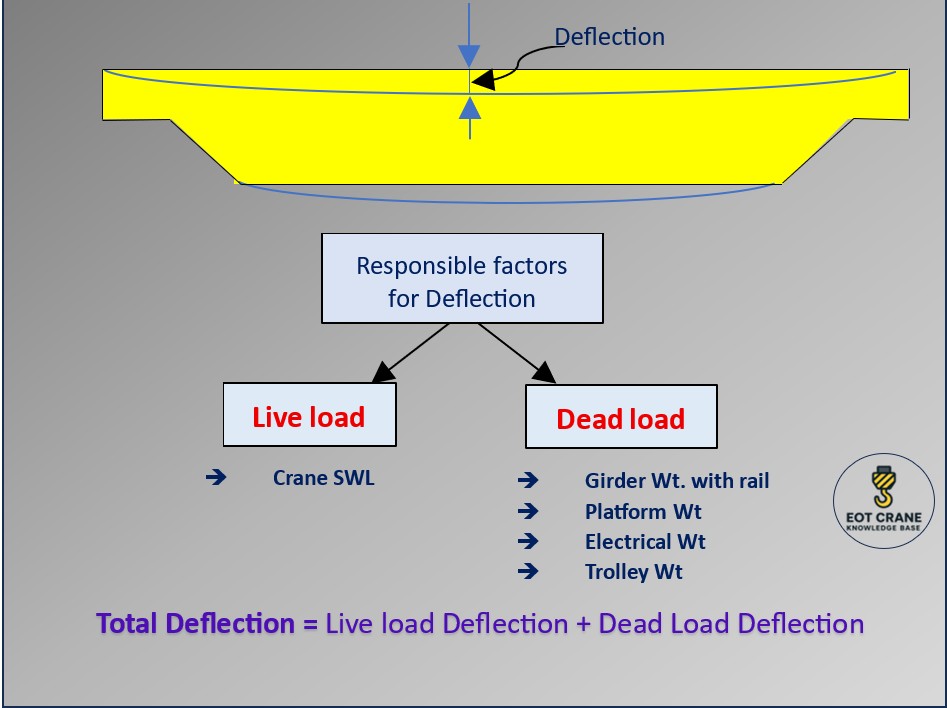
Deflection in girder is due to the dead load of components which are attached with girder & due to the live load(dynamic load).
Live load and dead load combine are the responsible for the deflection of girder. To counteract the downward deflection that will occur when the girder is loaded (self-weight + crane weight + lifted load).
Camber is the slight upward curvature intentionally provided to the girder to partially compensate for the downward deflection caused by the rated load and the weight of crane components.
Deflection in a girder occurs due to two factors — the dead load from the self-weight and permanently attached components, and the live (dynamic) load from the moving crane and lifted load.
The combined effect of dead and live loads is responsible for the total downward deflection of the girder. Camber is provided to counteract this expected deflection so that the girder remains nearly level under working conditions.
Camber – What It Is
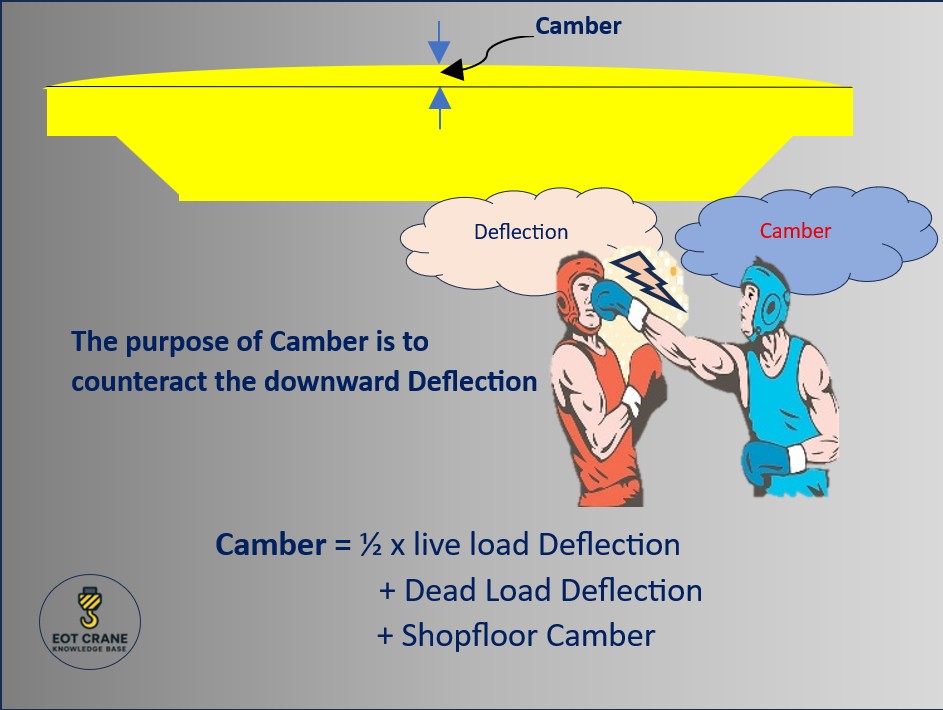
- Camber is the upward curvature intentionally provided in the EOT crane girder during fabrication.
- Purpose:
- To counteract the downward deflection that will occur when the girder is loaded (self-weight + crane weight + lifted load).
- To ensure that when the girder is under full load, it becomes almost straight (zero or very small sag).
- To avoid negative camber (permanent sag) during service.
- Usually, camber is given upwards at mid-span.
📐 2️⃣ Deflection – What It Is
- Deflection is the actual vertical displacement of the Crane girder under load (self-weight + live load).
- It is downward (sagging) and depends on:
- Span length
- Load magnitude and position
- Girder cross-section and moment of inertia
- Support conditions
Relevant Standards
- IS 807:2006 – “Design, Erection and Testing of Cranes and Hoists”
- IS 800 – “General Construction in Steel” (for cambering techniques)
- IS 3177 – For crane classification and service conditions.
FEM 1.001 – European crane standard (similar philosophy)
Design Tip
- Camber should be calculated, not just “eyeballed.”
- Incorrect camber leads to rail misalignment, trolley skewing, premature wheel wear, and crane vibrations.